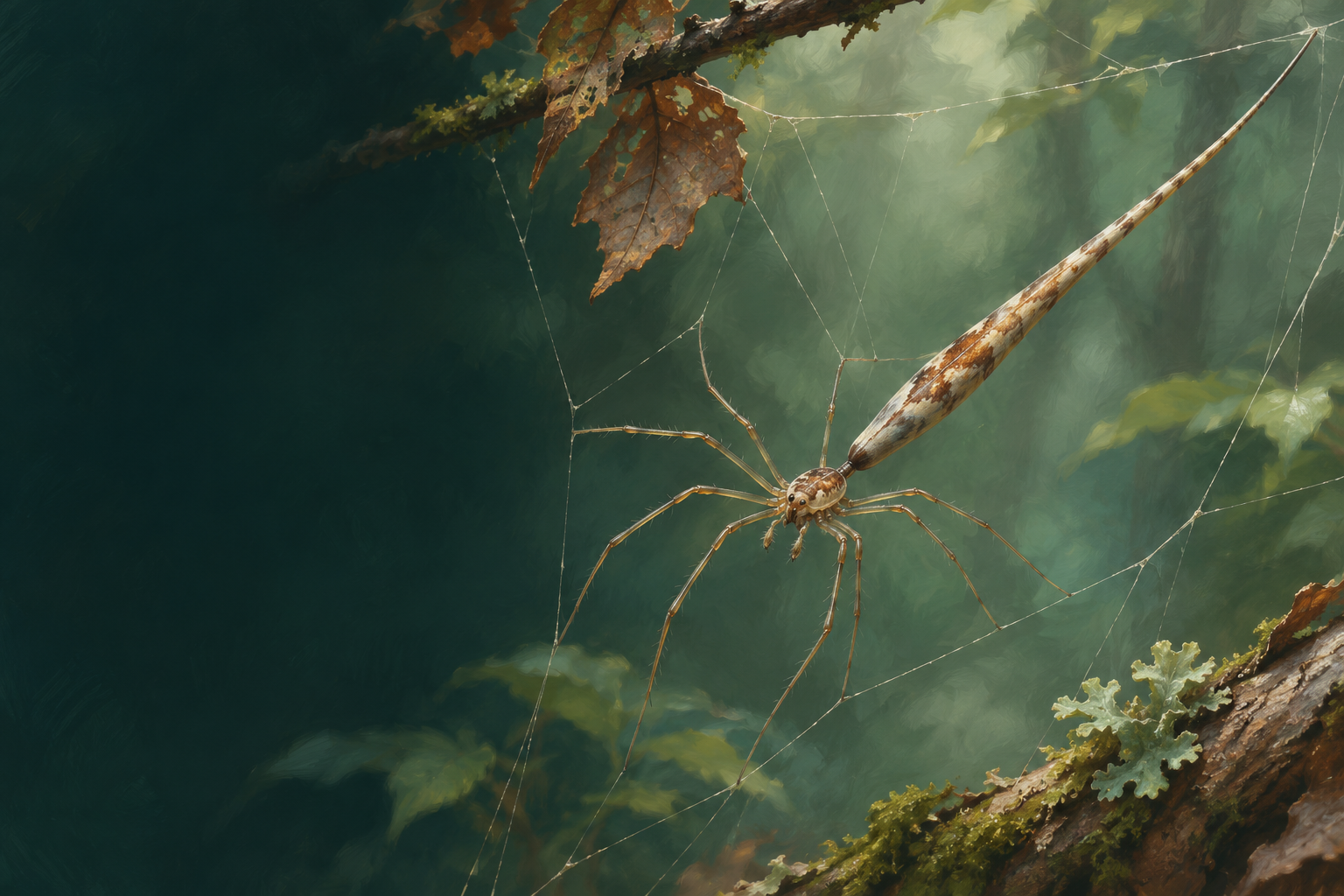
An unusual silhouette
Rhomphaea fictilium belongs to Theridiidae but does not fit the familiar image of a spider with a rounded abdomen. Its elongated rear body projects far beyond the small front body. Body plans can vary substantially even within a single family. This spider broadens that picture without needing an invented common name to make it interesting.
Evidence of spiders as food
Species-specific literature records several other spiders as prey, including inhabitants of different web types. This makes it more than a thief of already captured insects. Eating spiders and stealing their prey are different relationships with another animal’s web. Keeping them separate helps explain ecological roles rather than placing all unusual theridiids in one behavioural category.
Surprises in boreal forest
A study of Canadian collection material extended the picture of its northern occurrence into boreal forest. The catalog gives an overall range from Canada to Argentina. Such a statement connects widely separated records. It does not mean the species is equally abundant, or even documented, at every location between those two ends of its range.
Few records raise a research question
The Canadian study describes the species as rarely collected and discusses explanations for scattered records. That is not a global population census. Collection methods, seasons and habitats visited all influence what is found. This library values the combination of documented existence, unusual form and unanswered questions, rather than treating sparse records as a confident worldwide rarity ranking.
What do we know, and where are the limits?
Species-specific literature documents spider prey and Canadian records. Detailed experiments on an unidentified New Zealand Rhomphaea are not transferred to R. fictilium.
Sources & image credits
- World Spider Catalog · Rhomphaea fictilium ↗
- Paquin & Dupérré (2001) · Distribution and phenology of Argyrodes fictilium at its northern limit ↗
- Whitehouse (1987) · Spider eat spider: predatory behaviour of an unidentified Rhomphaea from New Zealand ↗
Sources and classification checked on 3 November 2026. Scientific names and interpretations may change with new evidence.