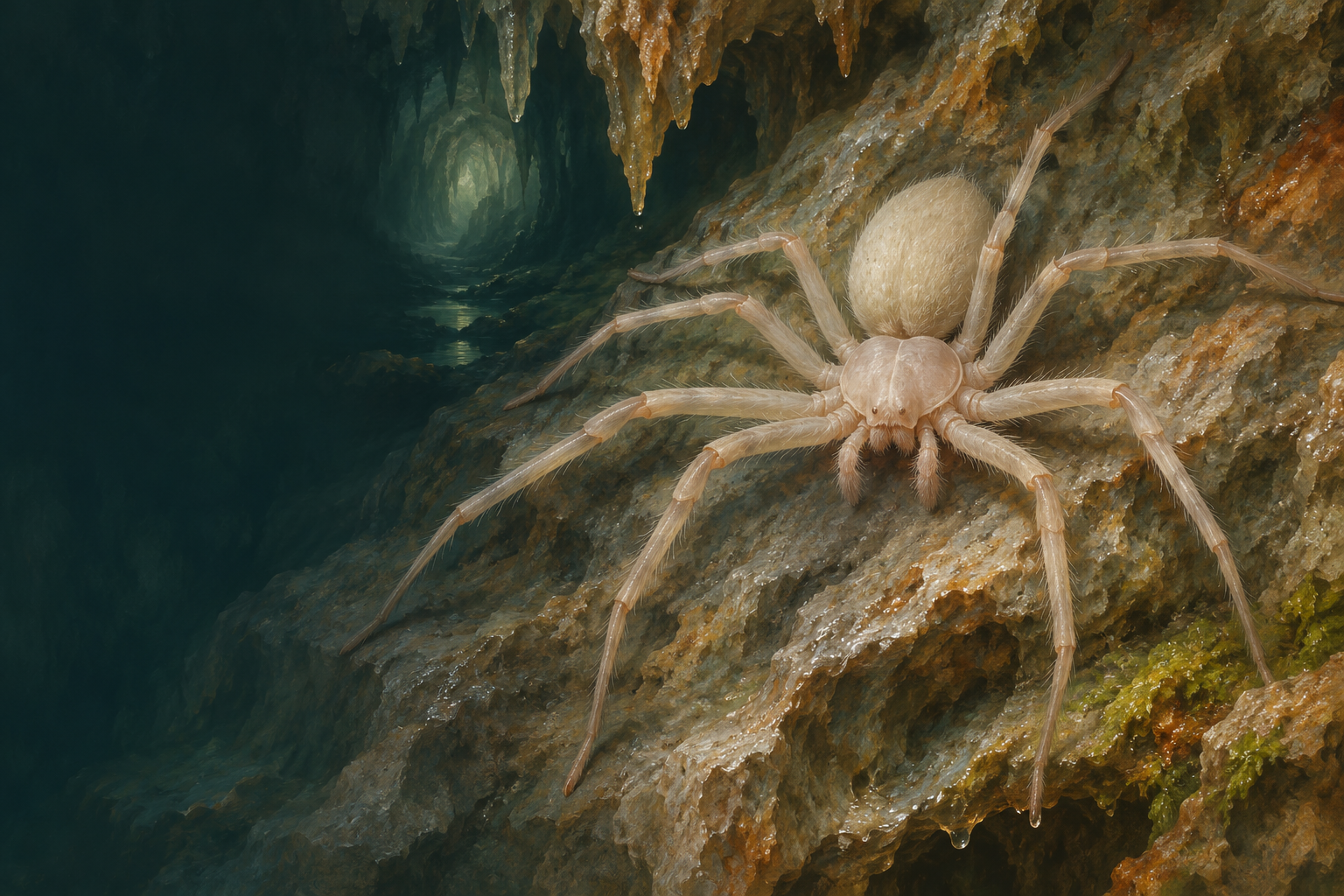
A face without eyes
Sinopoda scurion lacks eyes entirely. This distinguishes it from related cave spiders with reduced or still well-developed eyes. The comparison is what makes the discovery especially revealing: cave inhabitants do not automatically share identical equipment. The original study documented different conditions within one genus rather than treating underground life as a recipe for one uniform appearance.
Limestone and darkness
The species was described from a cave in Laos. Against pale limestone its lightly pigmented body appears understated, while the long, sideways-oriented legs remain unmistakable. A cave is not an empty chamber. Moisture, crevices and incoming organic material create small living spaces whose boundaries can matter more to an animal than the imposing cave entrance.
Perception without sight
Vision is only one way to detect surroundings. Spiders also possess mechanically sensitive hairs and can register movement through touch or vibration. This makes life without eyes biologically understandable. Exactly which signals Sinopoda scurion uses during a particular hunt, and how sensitively it responds, nevertheless requires observations and experiments directed at this species rather than assumptions from appearance.
Caves tell different stories
The discovery formed part of a revision of Laotian Sinopoda. Such systematic work is more than a list of spectacular animals: it compares characters, identifies differences and establishes identities that others can check. The eyeless species therefore earns its place here by showing how research reveals diversity that can be overlooked even within the same broad habitat.
What do we know, and where are the limits?
Eyelessness is described for this species. Its exact prey-search behaviour and sensory performance are not thereby fully explained experimentally; not all Sinopoda are eyeless.
Sources & image credits
- World Spider Catalog — Sinopoda scurion ↗
- Jäger (2012) — Revision of Sinopoda in Laos, including an eyeless huntsman ↗
Sources and classification checked on 3 November 2026. Scientific names and interpretations may change with new evidence.