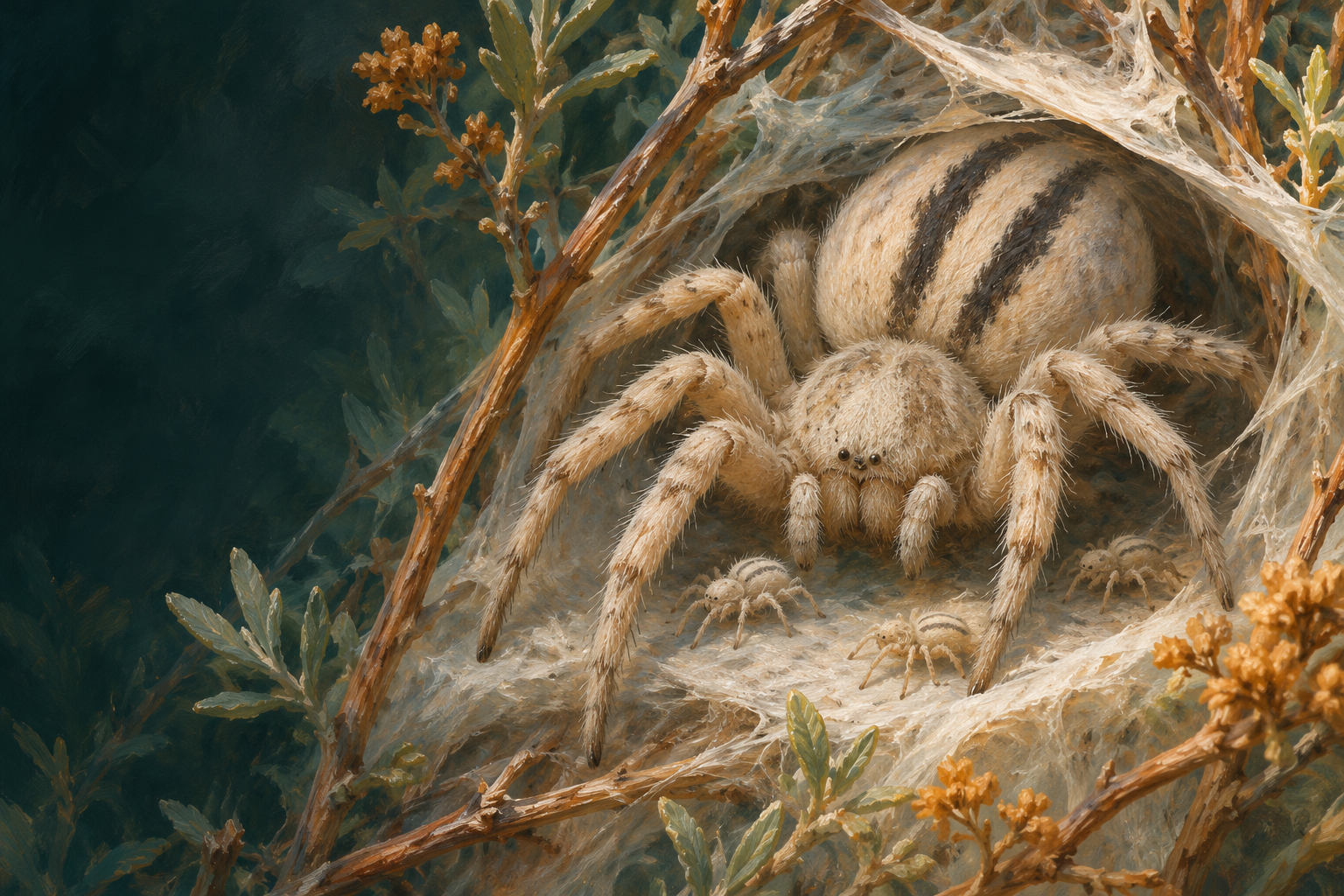
The web as a nursery
Among stems, silk creates a retreat around which the young initially live together. They do not immediately leave their mother as fully independent miniature hunters. This early stage combines maternal provisioning with contact among siblings. Such temporary association differs from a large permanent colony containing many reproducing females, a social arrangement found in some other spiders rather than automatically in this species.
Food from the mother’s body
The mother first transfers liquid food to her offspring. Studies reveal extensive changes in internal tissues during this provisioning phase. The behaviour therefore cannot be reduced to one dramatic final image. It is a physiological sequence with several stages, in which the maternal body progressively becomes a major food source for the developing young rather than simply remaining an unchanged container.
Matriphagy without a heroic story
Eventually the offspring consume their mother, a behaviour termed matriphagy. The term makes no claim about love, courage or a consciously chosen sacrifice. It describes a reproductive strategy whose tissue changes and nutrient transfers can be studied. This perspective does not remove the event’s emotional impact on a human viewer, but makes it more precise and comparable with other forms of parental investment.
From the Mediterranean eastward
The species occurs in parts of southern Europe, North Africa and Asia, linking several regions without implying identical conditions throughout. Its research value lies especially in studies combining behaviour with internal processes. Here the extraordinary feature is not an invented body shape but a life history that becomes visible through careful observation and laboratory work alongside the familiar external spider form.
What do we know, and where are the limits?
Species-specific studies document digestion, regurgitation feeding and matriphagy. This species should not be equated with permanently social Stegodyphus colonies; adults are predominantly solitary.
Sources & image credits
- World Spider Catalog — Stegodyphus lineatus ↗
- Araneae — Stegodyphus lineatus ↗
- Salomon et al. (2015) — Histological changes preceding maternal care ↗
- Junghanns et al. (2019) — Physiological Adaptations to Extreme Maternal and Allomaternal Care in Spiders ↗
Sources and classification checked on 3 November 2026. Scientific names and interpretations may change with new evidence.