Food from the mother’s body
The study published in 2018 describes spiderlings taking a nutritious secretion produced by their mother. Small droplets are initially made available in the retreat and later taken directly from her body. “Milk-like” describes the provisioning function; it does not imply mammalian mammary glands or anatomical identity with human breastfeeding.
Provisioning beyond first outings
The duration of care was especially striking. The described young continued to receive support after they could forage for themselves. Researchers therefore distinguished nutritional provisioning from the mother’s continued presence. This family association has several functions to investigate; it should not simply be treated as a miniature version of a human household.
Ant-like, without antennae
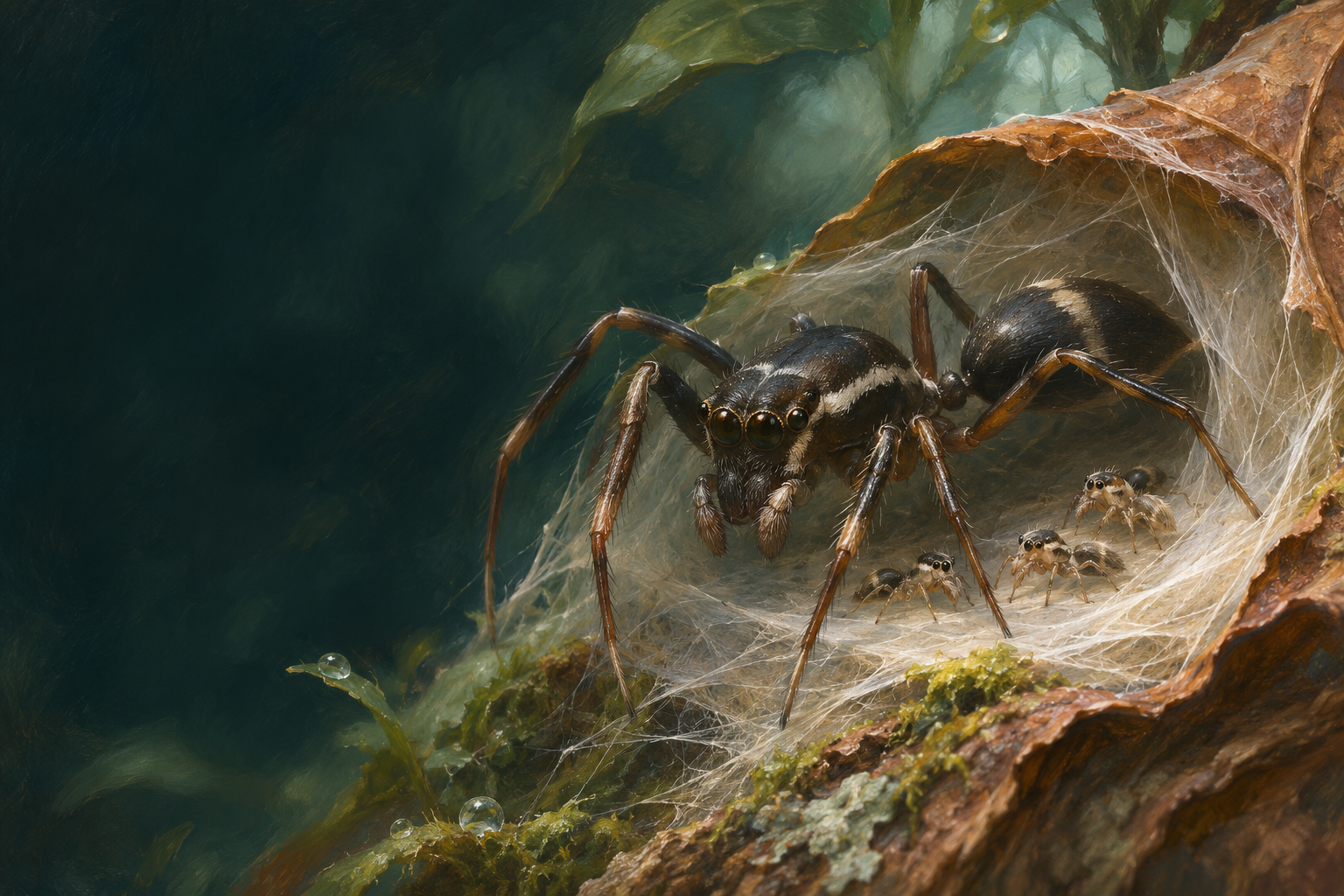
These jumping spiders have dark, ant-like bodies, but retain eight legs and lack antennae. The mother and her young occupy a silk-lined retreat. Provisioning takes place there, at a small scale and with anatomy fundamentally different from that of mammals. Their resemblance to ants and their prolonged care are distinct aspects of the same animal’s life.
Names keep research traceable
Extraordinary discoveries need careful attribution. The original publication used Toxeus magnus; newer research identifies the same study lineage as Toxeus maxillosus and explicitly corrects that earlier identification. We follow the newer attribution here. The catalogue records Toxeus maxillosus from Myanmar and China to the Philippines and parts of Indonesia.
What do we know, and where are the limits?
The 2018 study appeared under Toxeus magnus. Newer research corrects the identification to Toxeus maxillosus. The WSC lists these as separate species; results concern studied animals rather than automatically every population.
Sources & image credits
- World Spider Catalog · Toxeus maxillosus ↗
- Chen et al. (2018) · Prolonged milk provisioning in a jumping spider ↗
- Chen et al. (2019) · Milk provisioning and parental care: further questions ↗
- Maternal care and longevity in a milk-provisioning jumping spider (2024) ↗
- Sex role-dependent behavioural and architectural divergence ↗
- Creative problem solving in a jumping spider · corrected identification ↗
Sources and classification checked on 3 November 2026. Scientific names and interpretations may change with new evidence.