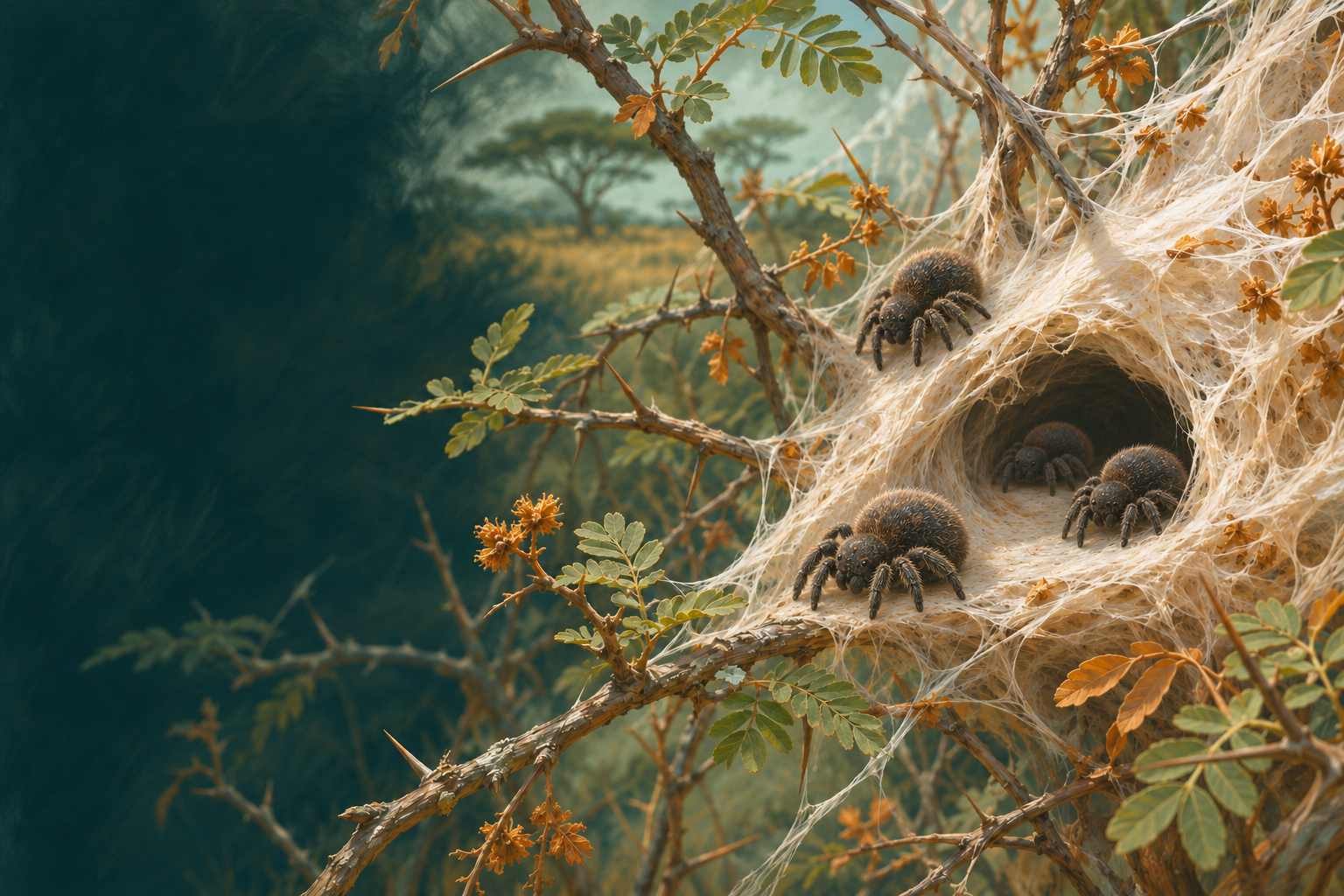
A southern African setting
The known range covers several southern African countries, including Namibia, Botswana and South Africa. It cannot be reduced to a single landscape type. This social spider is not a model for all African spiders either: the same continent supports many other lineages and hunting methods.
Retreat and capture surface
A colony constructs a dense three-dimensional silk retreat with associated capture sheets. Several animals can use the same structure. The protected shelter and the surface that intercepts prey serve different purposes. A dense silk ball seen from outside therefore does not describe the entire web system.
Hunting as a collective response
Prey produces vibrations in the capture web. Experiments with Stegodyphus dumicola show that proximity between colony members and prey signals influence collective hunting. Here, social means observable shared living and coordinated activity. It implies neither human intentions nor a fixed division of labour like that of honeybees.
Cooperation also has costs
Comparative studies of Stegodyphus show benefits of cooperative foraging alongside competition within groups. Shared prey must feed several animals. The useful question is therefore not whether group living is always better, but under which conditions benefits and costs change. Colony size, prey availability and habitat need to be considered together.
Sources & image credits
- World Spider Catalog · Stegodyphus dumicola ↗
- Spatial proximity and prey vibratory cues influence collective hunting in social spiders ↗
- Cooperative foraging expands dietary niche but does not offset intra-group competition for resources in social spiders ↗
Sources checked: 2 November 2026. Comparisons carry the qualifications stated in each article.