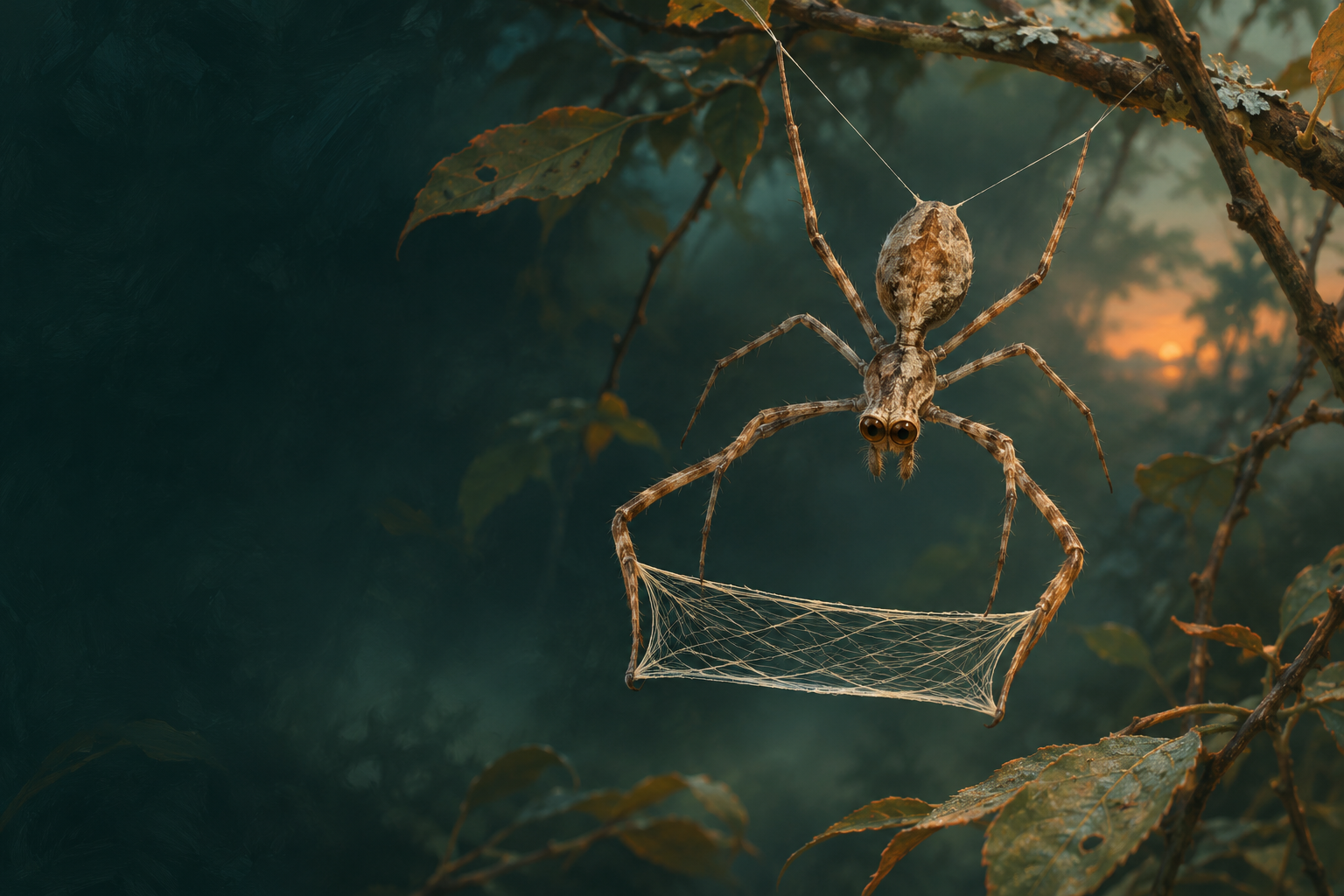
A net held between the legs
Deinopid net-casting spiders hold a small extensible net in front of the body. During capture it is stretched over nearby prey. The Australian Museum describes woolly cribellate silk in Asianopis that entangles prey. This movable capture device operates differently from a large surface remaining stretched between branches.
The bolas as a moving sticky point
Female Ordgarius magnificus use a short line ending in a sticky globule at night. As a moth approaches, the spider can move the line and draw attached prey closer. The museum account also describes chemical deception in attracting male moths. This example combines material, sensing and movement; the sticky globule alone does not explain the whole hunt.
Specialisation has an environment
A capture device suits particular encounters, including available prey, light and supporting vegetation. One studied species therefore cannot establish a rule for all spiders. Even among net-casting spiders, eye proportions differ between Asianopis and Menneus. Neither a striking tool nor a similar name replaces attention to the species concerned.
Three questions for comparison
First ask where the silk is anchored, then who moves it, and finally what restrains the prey. These questions distinguish functions in superficially similar threads. Our artistic images convey a motif. Documented observations and recordings are more informative about the sequence of a strike than one illustration.
Sources & image credits
- Australian Museum · Net-casting Spiders ↗
- Australian Museum · Magnificent Spider, Ordgarius magnificus ↗
Sources checked: 2 November 2026. Comparisons carry the qualifications stated in each article.