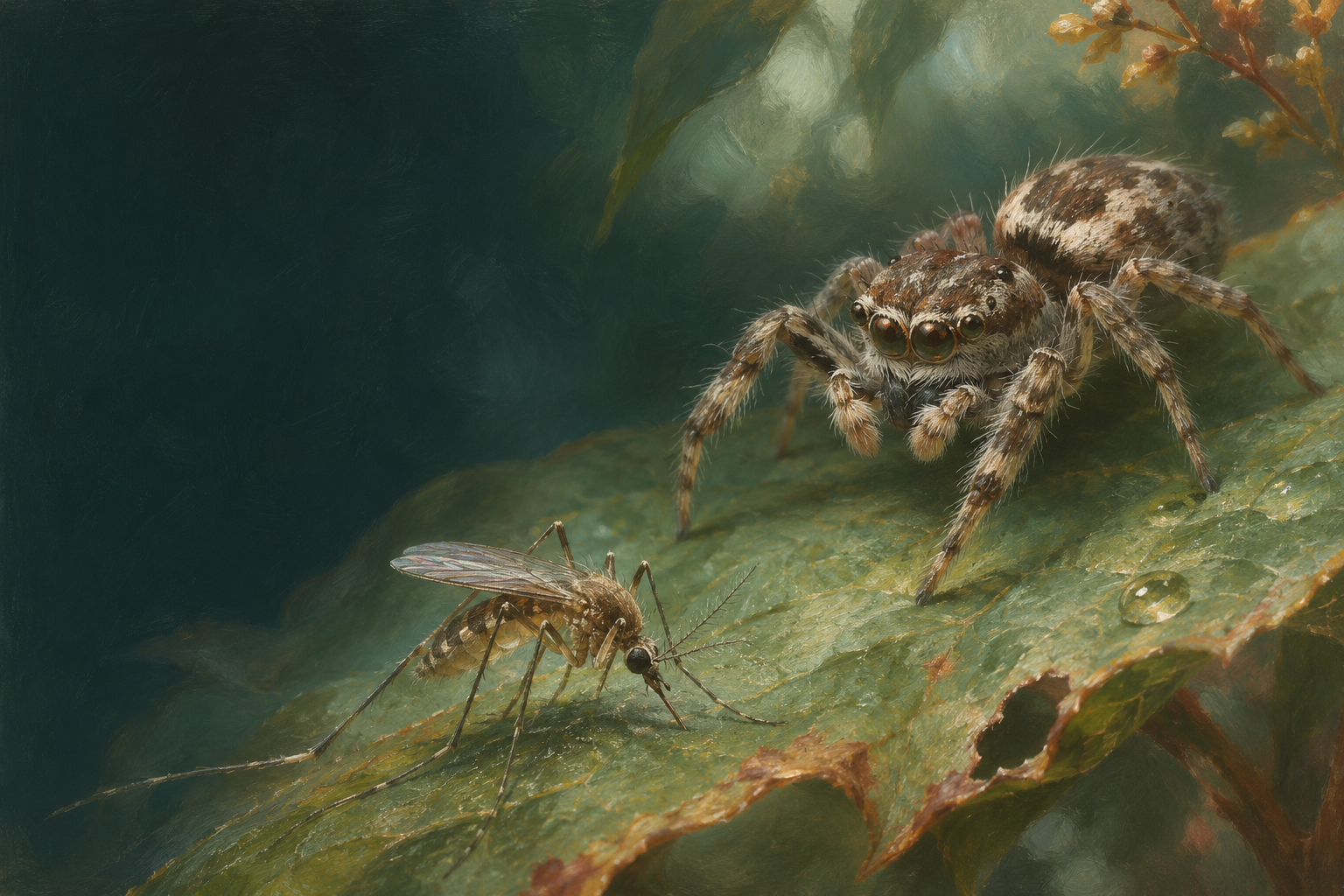
Blood at second hand
Evarcha culicivora hunts insects and, in experiments, prefers female mosquitoes that have previously taken a blood meal. It does not pierce vertebrate skin to obtain that food. Instead it reaches the resource through a mosquito’s already-filled body. This makes its feeding biology quite different from the misleading image of a blood-sucking spider.
More than a red abdomen
The choice is not explained by a single colour alone. Experiments using altered images and models separate abdominal cues from features on the mosquito’s head and thorax. Researchers can therefore ask which combination the spider recognises. A human description such as “looks appetising” cannot replace testing the actual information available to this predator.
Odours matter too
Researchers have also investigated odour cues. These can provide information about possible prey and even about a potential mate’s diet. The story therefore extends beyond the conspicuous eyes of a jumping spider. Perception involves several information channels, and their importance can change between feeding decisions and encounters with other spiders.
An East African specialist
The catalogue records Kenya and Uganda. This portrait highlights the combination of field observations and controlled experiments: the species is interesting because its choices have been repeatedly investigated, not merely because one feeding scene looks unusual. The consequences of those preferences for entire mosquito populations are a separate ecological question.
What do we know, and where are the limits?
Multiple experiments examine visual and odour cues alongside natural prey. Preference for particular mosquitoes does not demonstrate effective control of human disease.
Sources & image credits
- World Spider Catalog · Evarcha culicivora ↗
- Jackson, Nelson & Sune (2005) · A spider that feeds indirectly on vertebrate blood ↗
- Nelson & Jackson (2012) · Fine tuning of vision-based prey choice ↗
- Cross et al. (2009) · Mate-choice decisions and diet-related odour ↗
- Natural prey and prey preferences of Evarcha culicivora ↗
Sources and classification checked on 3 November 2026. Scientific names and interpretations may change with new evidence.