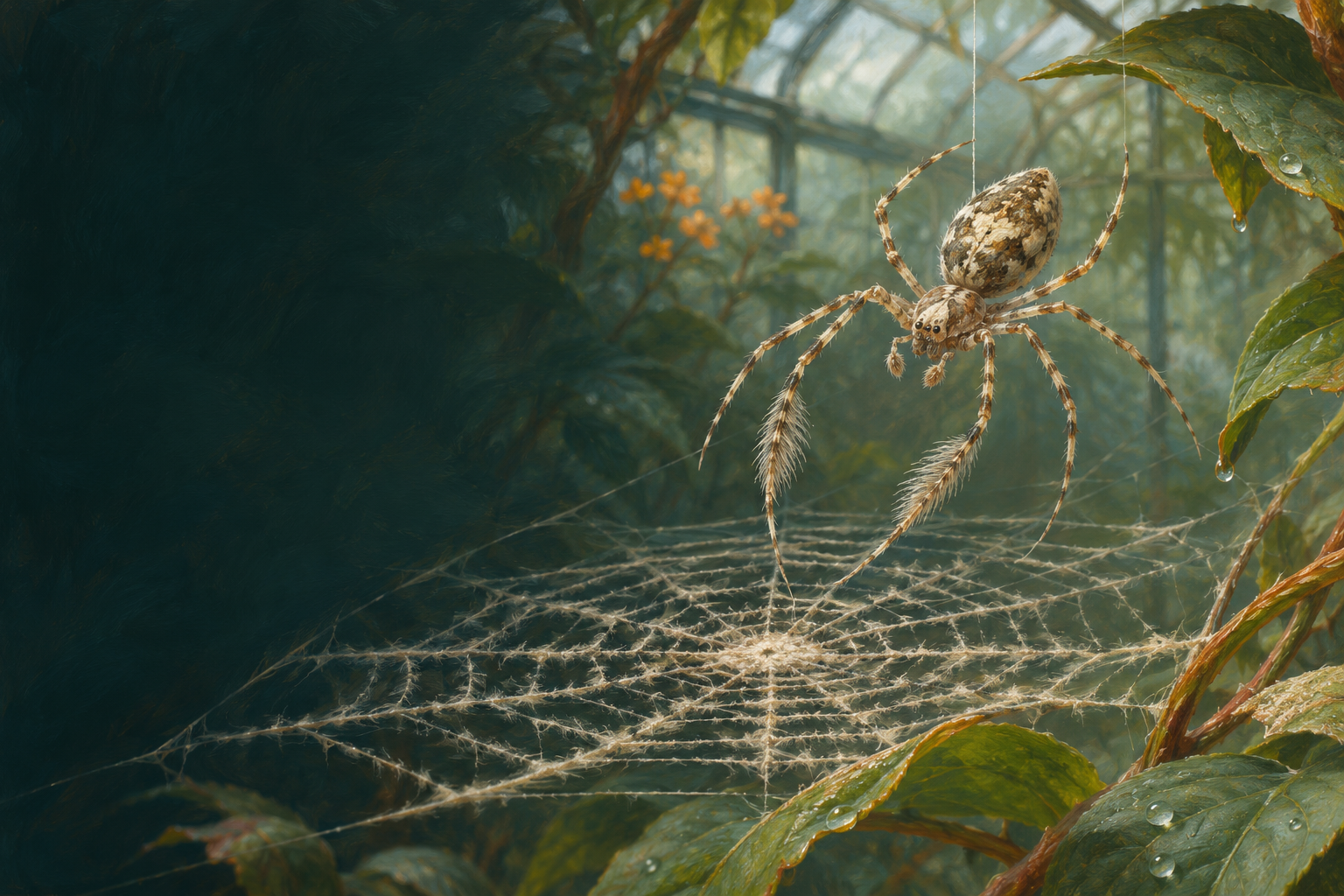
Feathered legs in the greenhouse
Females carry conspicuous tufts of long hairs on their front tibiae. At rest, the whole spider can resemble a scrap of dry vegetation rather than a familiar orb weaver. In parts of Europe it inhabits warm greenhouses. Transport with plants helps explain such occurrences and connects its story with everyday horticulture and movement of goods.
Capture wool instead of visible glue drops
Capture threads contain a mesh of extremely fine fibres. This cribellate silk emerges from a specialised spinning plate and is processed with a leg comb. Capture wool describes its open structure better than the image of a wet glue-coated line. Numerous tiny contacts enlarge the interface when an insect encounters a thread in the web.
The prey’s surface matters too
Experiments show that waxy material on an insect’s outer surface can influence the adhesion of cribellate threads. Prey is therefore not interchangeable with a smooth laboratory surface. Material performance emerges through contact between two surfaces. A thread that adheres weakly to glass need not behave identically against the outer covering of a real insect.
An orb with its own material history
Uloborus plumipes combines a familiar overall shape, the orb web, with a less familiar capture material. That difference earns its place here, rather than any claim of worldwide rarity. Comparing webs invites a closer look at thread surfaces: similar patterns do not reveal whether droplets or a dry fibre mat hold the prey in place.
What do we know, and where are the limits?
Capture silk has been studied microscopically and mechanically in U. plumipes. Electrical effects form part of the discussion, not a sole explanation for all adhesion.
Sources & image credits
- World Spider Catalog · Uloborus plumipes ↗
- Kronenberger & Vollrath (2015) · Spiders spinning electrically charged nano-fibres ↗
- Bott et al. (2017) · Adhesion enhancement of cribellate capture threads by epicuticular waxes ↗
- British Arachnological Society · Uloborus plumipes ↗
Sources and classification checked on 3 November 2026. Scientific names and interpretations may change with new evidence.