Together rather than merely adjacent
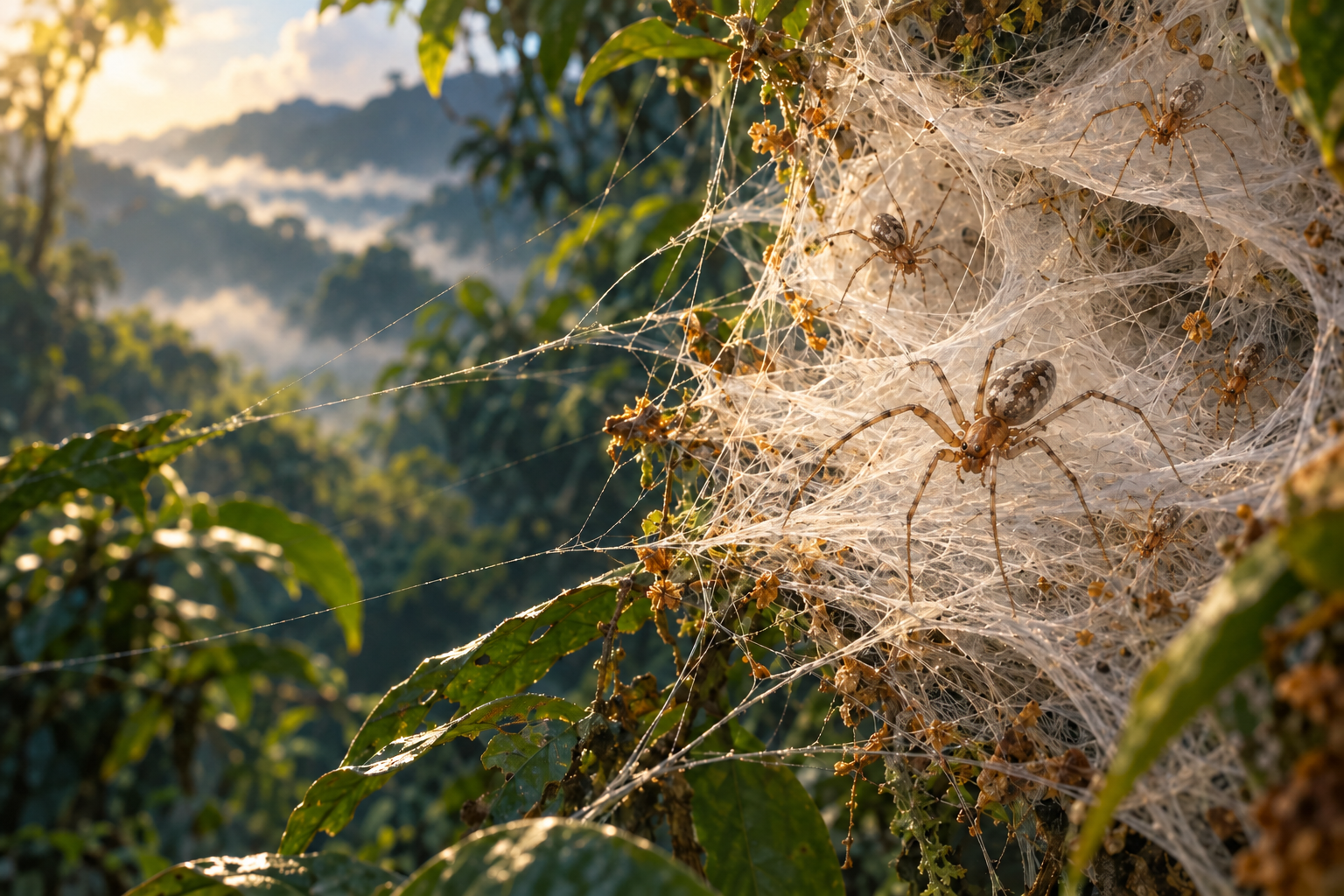
Many spiders live largely alone. In this species, colony members share a large communal web and cooperate in prey capture. This is more than a cluster of neighbouring individual webs: the shared structure connects their activities.
Sharing access to large prey
Field research found that larger colonies captured larger insects. Such prey can contribute to the community’s energy supply. This does not mean group living offers unlimited benefits: web area, food and colony size remain connected.
Cooperation is not uniformity
Not every spider needs to perform the same action during a capture. Prey size and how long food remains usable also matter to group feeding. This is one particular social way of life, not a rule for all spiders or a model of human society.
Sources & image credits
- Yip, Powers & Avilés (2008) · Cooperative capture of large prey solves scaling challenge faced by spider societies ↗
- Rypstra & Tirey (1991) · Prey size, prey perishability and group foraging in a social spider ↗
Sources checked: 2 November 2026. Comparisons carry the qualifications stated in each article.